
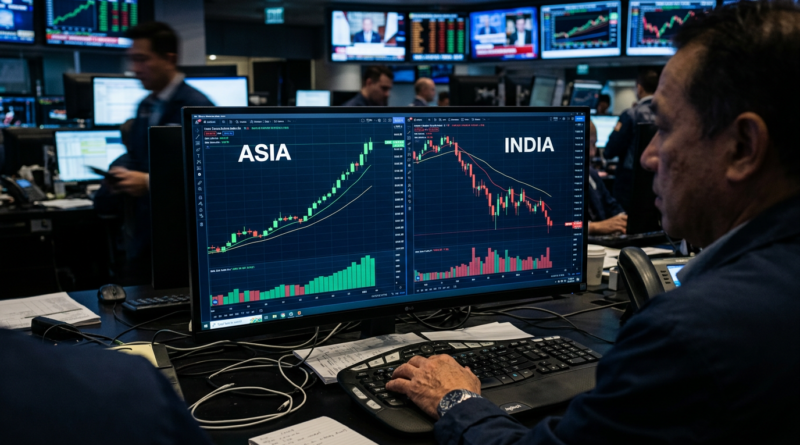
Indian Market Underperforms as Asia Rallies: Decoding the Divergence
Indian Market Underperforms as Asia Rallies: Decoding the Divergence
Indian benchmark indices diverged sharply from their Asian peers in a recent trading session, succumbing to domestic pressures while regional markets surged on positive global cues. This tale of two trends highlights a complex interplay of international sentiment and local market dynamics.
While major Asian bourses, including Japan’s Nikkei 225 and Hong Kong’s Hang Seng, posted significant gains, India’s BSE Sensex and NSE Nifty 50 buckled, closing the day in negative territory. According to reports from The New Indian Express, this decoupling underscores a distinct set of challenges currently facing the Indian equity market, even as broader sentiment in the region turned bullish. Final figures detailing the exact percentage change for the indices are being compiled.
Key Analysis: Drivers of the Divergence
Tailwinds for Asian Equities
The broad-based rally across Asia was largely fueled by optimism from the United States. Market observers note that softer-than-expected US inflation data has bolstered investor hopes that the Federal Reserve may be prompted to cut interest rates sooner than previously anticipated. This sentiment typically weakens the US dollar and improves the outlook for global risk assets, providing a significant tailwind for emerging and developed markets across the Asian continent.
Headwinds for Indian Indices
In stark contrast, Indian markets grappled with significant selling pressure, primarily from Foreign Institutional Investors (FIIs). Analysts suggest this trend is driven by a combination of factors. Pre-election caution, with investors pausing ahead of the general election results, is seen as a major contributor. Furthermore, some market watchers believe that Indian equities, having outperformed many global peers over the last year, are trading at premium valuations, prompting foreign funds to book profits and reallocate capital to more attractively priced markets.
Why This Matters in the Long Run
The current divergence underscores the Indian market’s sensitivity to foreign capital flows. While robust and consistent investment from Domestic Institutional Investors (DIIs) has often acted as a buffer against FII outflows, a sustained period of heavy selling by foreign funds can test market resilience. This underperformance may be a temporary phase linked to the election cycle, with sentiment expected to stabilize post-results. However, it serves as a critical ledger entry for investors, highlighting the ongoing tug-of-war between India’s strong domestic growth story and the influence of global macroeconomic trends and investor sentiment. A reversal of the FII selling trend will likely be a key catalyst for the market’s next directional move.
Looking ahead, the trajectory for Indian equities will be closely tied to the clarity on policy direction post-elections, monsoon performance, and the evolving global interest rate environment, particularly the actions of the US Federal Reserve and the Reserve Bank of India (RBI).
READ ALSO:
Disclaimer: This article is AI-generated and is for informational purposes only. It does not constitute financial, investment, or legal advice. Always consult a qualified professional before making financial decisions.
This article was generated by AI based on publicly available news sources and may contain inaccuracies. For the original reporting, please refer to the cited sources. Learn more about our AI policy.