
India’s Market Is No Longer Just A Foreigners’ Game – Outlook Money

A Structural Shift in Indian Equities
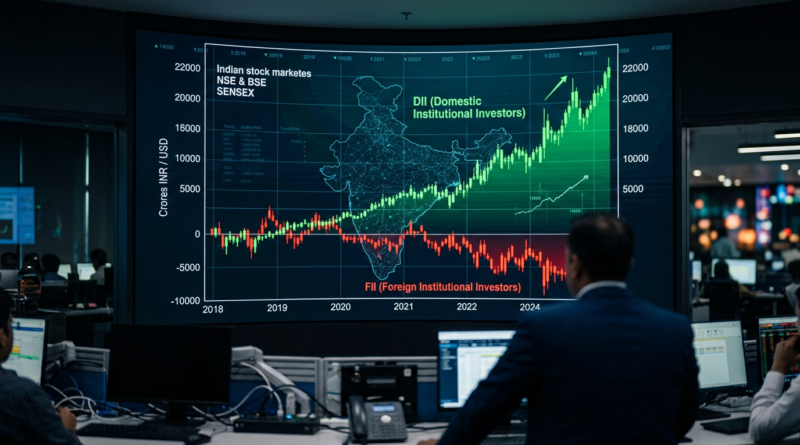
A fundamental and enduring transformation is underway in the Indian stock market, signaling a decisive departure from its long-standing dependence on foreign capital. The market’s recent resilience and sustained rally, even amidst significant outflows from Foreign Institutional Investors (FIIs), are directly attributable to the rising influence of domestic investors. This structural shift, powered by a surge in retail and domestic institutional participation, indicates a maturing market that is becoming increasingly insulated from the whims of global capital flows. This evolution, as analyzed in a report by Outlook Money, suggests a new era of self-reliance for Indian equities.
Historically, the direction of Indian benchmark indices like the Nifty 50 and BSE Sensex was heavily dictated by the investment patterns of FIIs. A period of heavy FII selling would almost certainly trigger a market correction. However, this paradigm is demonstrably changing. Domestic Institutional Investors (DIIs), including mutual funds and insurance companies, alongside a burgeoning base of retail investors, are now providing a powerful and consistent counterbalancing force. This was evident during recent periods where FIIs were net sellers; the market did not experience a major crash, cushioned instead by robust domestic buying. While the precise net outflow from FIIs for that period is still being finalized, market observers agree the trend of domestic absorption was unmistakable.
The Pillars of Domestic Dominance
The Systematic Investment Plan (SIP) Revolution
The primary engine of this domestic wave is the widespread adoption of the Systematic Investment Plan (SIP). SIPs allow millions of Indians to invest a fixed amount of money in mutual funds at regular intervals, fostering a culture of disciplined, long-term investing. This mechanism channels a steady, predictable flow of capital into the equity markets, regardless of short-term sentiment. According to industry observers, annual inflows through SIPs have reached record levels, although the final, consolidated figures for the most recent fiscal year are not yet confirmed. This consistent flow provides a stable demand floor for equities, making the market less susceptible to sudden shocks. The total Assets Under Management (AUM) for the Indian mutual fund industry have consequently swelled to unprecedented levels, with final audited figures for the latest quarter still pending confirmation.
DIIs: The Long-Term Shock Absorbers
The consistent inflow from DIIs now acts as a crucial shock absorber against global volatility. Unlike some foreign funds that may react quickly to global economic cues, such as interest rate hikes by the U.S. Federal Reserve, domestic institutions often have a longer-term investment horizon. Pension funds and insurance companies, for instance, are investing to meet long-term liabilities, making them natural buyers during market dips. This dynamic prevents the sharp, panic-driven corrections that previously characterized periods of FII exodus. Market analysts widely note that this structural shift reduces overall market volatility and fosters a more stable environment conducive to long-term wealth creation for all participants.
READ ALSO:
Implications for Market Health and the Future
The growing dominance of domestic investors is more than a cyclical trend; it is a long-term structural change with profound implications for the economy. This shift represents a broader ‘financialization’ of domestic savings, where households are increasingly moving away from physical assets like gold and real estate towards financial assets like equities. This transition is facilitated by increased financial literacy and the proliferation of digital investment platforms that have democratized access to the stock market.
This redirection of capital is vital for the nation’s economic growth, as it channels household savings into productive corporate investments, fueling expansion and job creation. Furthermore, despite the market’s strong performance, many analysts believe it is not in an overextended bubble. Key valuation metrics, such as the market-cap-to-GDP ratio, are considered by many to be within a reasonable range, supported by strong corporate earnings growth. This suggests the current rally is underpinned by solid fundamentals. In the long run, a market funded predominantly by its own domestic savings is inherently more resilient, stable, and aligned with the country’s own economic trajectory, marking a significant step in the maturation of India’s capital markets.
This article was generated by AI based on publicly available news sources and may contain inaccuracies. For the original reporting, please refer to the cited sources. Learn more about our AI policy.