
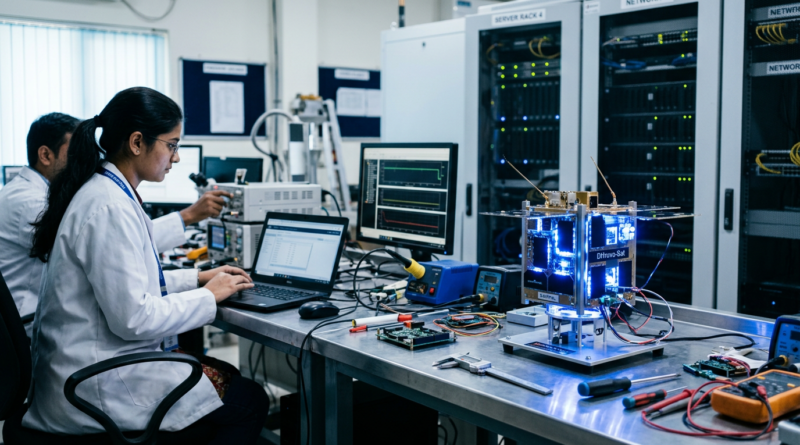
India’s Deeptech Boom: Startups Move From Software to Satellites
India’s vaunted startup ecosystem, long defined by its prowess in software-as-a-service (SaaS) and consumer tech, is undergoing a fundamental and strategic pivot. A new wave of entrepreneurs is moving beyond code, venturing into the complex, capital-intensive world of ‘deeptech’—tackling challenges in sectors from space exploration and biotechnology to advanced materials and quantum computing.
As reported by YourStory.com, the narrative of Indian innovation is expanding from ‘bits to atoms’. This shift signifies a maturation of the ecosystem, where venture capital is beginning to embrace longer-term, research-and-development-heavy bets over businesses with quicker, software-based scaling models. Deeptech startups are characterized by their focus on creating tangible intellectual property and solving fundamental scientific or engineering problems, a departure from business model innovations that powered the last decade of growth.
Key Analysis: The New Frontier for Venture Capital
Industry observers note that this transition is fueled by a convergence of talent, capital, and policy. India now possesses a critical mass of experienced engineers and scientists, many with exposure to global R&D hubs, who are returning to launch their own ventures. Simultaneously, venture capital firms are evolving, recognizing that the next multi-billion dollar opportunities may not come from another e-commerce platform, but from a company that develops a novel battery technology or a cost-effective satellite launch system.
From Seed to Series C: The Funding Trajectory
While early-stage (Seed and Series A) funding for deeptech has become more accessible, with investors like Blume Ventures, Peak XV Partners, and Accel actively scouting for opportunities, the primary challenge lies in securing patient, long-term capital for later stages. Unlike SaaS companies, deeptech ventures have extended gestation periods before generating revenue. Their journey from lab to market requires significant investment in prototyping, regulatory approvals, and specialized manufacturing. Market analysts suggest that for the ecosystem to thrive, a robust pipeline of Series B, C, and beyond funding is critical, which is currently a developing area in the Indian market compared to global peers in the United States or Israel.
Global Benchmarking: India’s Unique Proposition
India’s deeptech moment is not merely about replicating Western models. Instead, it is defined by a unique brand of ‘frugal innovation’. Startups in the space-tech sector, for example, are gaining global attention for their ability to dramatically lower the cost of building and launching satellites. This cost-competitiveness, combined with a large domestic market and supportive government policies like the privatization of the space sector, gives Indian deeptech a distinct advantage. While the US may lead in foundational AI research and biotech, India is carving a niche in the application and scalable deployment of these complex technologies.
Why This Matters in the Long Run
The rise of deeptech is more than a venture capital trend; it is a matter of strategic national importance. Developing sovereign capabilities in areas like semiconductors, defense technology, green hydrogen, and advanced healthcare reduces import dependency and positions India as a critical node in global supply chains. These ventures build foundational intellectual property within the country, moving India up the global value chain from a technology services provider to a technology creator. Success in this domain will not only generate economic value but also provide indigenous solutions to India’s most pressing challenges in climate, energy security, and public health.
As capital and talent continue to flow into this demanding sector, the key question is whether the ecosystem can build the necessary infrastructure—from specialized labs to patient, long-duration funds—to support these ambitious ventures from inception to global scale.
READ ALSO:
Disclaimer: This article is AI-generated and is for informational purposes only. It does not constitute financial, investment, or legal advice. Always consult a qualified professional before making financial decisions.
This article was generated by AI based on publicly available news sources and may contain inaccuracies. For the original reporting, please refer to the cited sources. Learn more about our AI policy.