
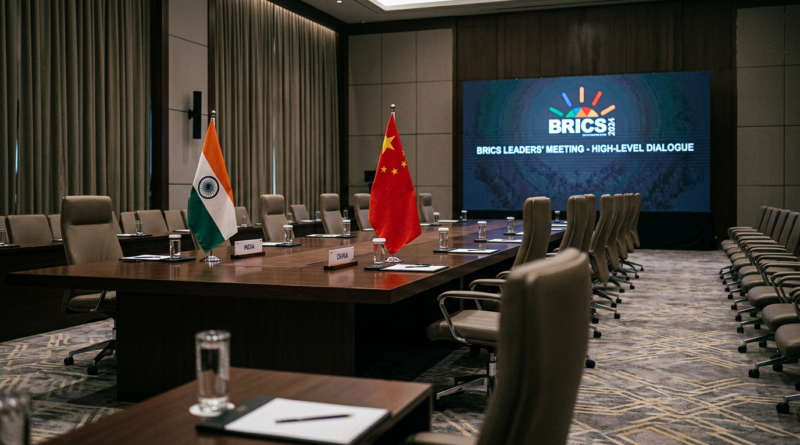
BRICS 2026: A Retrospective on the India-China Cooperation Puzzle
August 29, 2026 – The question of whether India and China can truly cooperate within the BRICS framework remains as pertinent today as it was when economist Jim O’Neill, the very architect of the term ‘BRIC’, began questioning the bloc’s geopolitical evolution. As we stand in 2026, looking back at the trajectory of this influential grouping, the Sino-Indian relationship continues to be its most complex and defining internal challenge.
The original concept, floated in the early 2000s, was economic. O’Neill identified Brazil, Russia, India, and China as future powerhouses of the global economy. The formalization of the bloc, including South Africa, was a political act that transformed an investment thesis into a geopolitical forum. This transformation has been a source of both strength and internal friction, a dynamic best exemplified by the New Delhi-Beijing axis.
Key Analysis: Economic Logic vs. Geopolitical Reality
The central tension within BRICS has always been the divergence between its economic potential and its political ambitions. As commentary from figures like O’Neill highlighted in years past, the bloc’s purpose has often been debated. Is it an economic engine for the Global South, or a political counterweight to Western-led institutions like the G7? The answer, as developments have shown, depends on which capital you ask.
The Divergent Paths of New Delhi and Beijing
For China, BRICS has consistently been viewed as a key platform to reshape the global order and challenge the post-war international system. Beijing’s strategic imperatives have often driven the bloc’s agenda, from the creation of the New Development Bank (NDB) to pushing for expansion.
India, conversely, has navigated its BRICS membership with a more cautious, multi-aligned approach. While supportive of a multipolar world, New Delhi remains wary of any bloc that could become overtly anti-Western or dominated by a single member’s agenda. The unresolved border disputes, which saw significant flare-ups in the early 2020s, have cast a long shadow, making deep strategic trust between the two Asian giants elusive. For India, cooperation on global platforms like the G20 and the UN often runs parallel to managing deep-seated strategic competition with China.
Expansion and Its Unintended Consequences
The expansion of BRICS, which brought in several new members over the past few years, was intended to bolster the bloc’s global standing. However, it has also complicated the internal India-China dynamic. While it diluted the direct power of any single member, it also introduced new alignments and potential proxy rivalries, forcing both India and China to manage a more complex set of relationships within the expanded forum.
Why This Matters in the Long Run
The ability, or inability, of India and China to find a stable cooperative equilibrium will dictate the ultimate fate of BRICS. If the bloc is perpetually hampered by the strategic rivalry of its two largest members, it risks failing to achieve its potential as a transformative force in global governance. The world is watching to see if the economic logic that first brought these nations together can eventually override the geopolitical frictions that continue to pull them apart. The effectiveness of BRICS as an institution—and its challenge to the established global order—hinges on the answer.
Ultimately, the question posed years ago remains unanswered: Can the ‘C’ and the ‘I’ in BRICS work together for a common purpose, or are their national interests too divergent for sustained, meaningful cooperation?
Frequently Asked Questions
What was economist Jim O’Neill’s original concept for BRIC?
Jim O’Neill’s original concept was purely economic, identifying Brazil, Russia, India, and China as future powerhouses that would drive global economic growth, not as a political alliance.
What is the primary challenge to India-China cooperation within BRICS?
The primary challenge stems from deep-seated strategic rivalry, including unresolved border disputes and divergent views on the global order, with China seeking to challenge the West and India preferring a multi-aligned foreign policy.
How has the BRICS bloc evolved since its inception?
BRICS has evolved from an economic concept into a formal political and geopolitical forum, complete with its own institutions like the New Development Bank and an expanding membership.
This article was generated by AI based on publicly available news sources and may contain inaccuracies. For the original reporting, please refer to the cited sources. Learn more about our AI policy.