
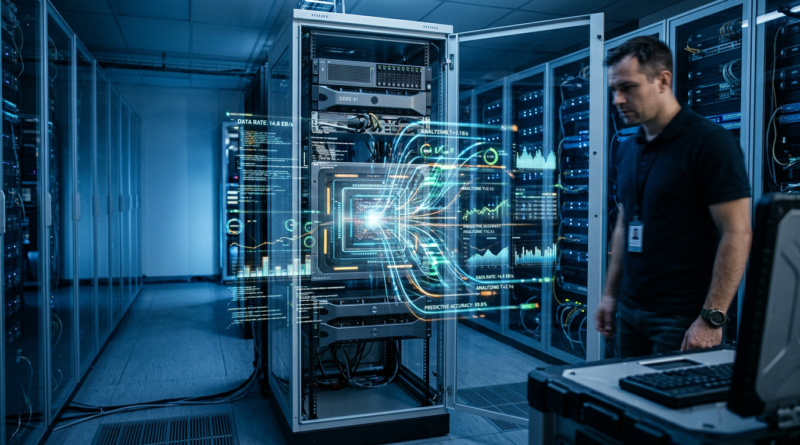
Faster Than Real-Time AI: Analyzing the New Performance Frontier
Category: healthcare/” target=”_blank” rel=”noopener”>Artificial Intelligence
A new threshold in computational performance has been crossed, with advanced artificial intelligence models now capable of processing information faster than it occurs in the real world. This development, highlighted in recent industry reporting, marks a pivotal shift from reactive to pre-emptive analytical capabilities, carrying profound implications for technology and society.
The concept of “real-time” processing has long been a benchmark for AI, particularly in applications like video analysis or autonomous navigation, where the system must keep pace with live data streams. However, as noted in a report by StartupHub.ai, a new class of models has surpassed this barrier. Faster-than-real-time (FTRT) performance means an AI can ingest a segment of data—for instance, one second of video footage—and complete its analysis and prediction in a fraction of that time, effectively seeing into the immediate future of the data stream.
Key Analysis: From Reaction to Prediction
The significance of FTRT performance lies not merely in speed, but in its transformative impact on decision-making. For decades, AI has been an exercise in catching up to reality; now, it can get ahead of it. This leap is the result of concurrent breakthroughs in both hardware, such as specialized processing units (TPUs and GPUs), and highly efficient software algorithms that optimize computational pathways. Instead of analyzing what just happened, these systems can now forecast what is about to happen with a high degree of accuracy, based on incoming data patterns.
Industry observers note several sectors poised for immediate disruption. In finance, FTRT algorithms could revolutionize high-frequency trading by predicting micro-second market fluctuations before they fully materialize. For autonomous vehicles, it means the ability to anticipate the trajectory of a pedestrian or another car not just based on current speed, but on a predictive model that runs faster than the event itself, allowing for smoother and safer collision avoidance. In cybersecurity, it enables a shift from detecting an ongoing attack to neutralizing a threat vector the moment its malicious pattern begins to form.
The Governance and Ethical Dilemma
While the benefits are substantial, the advent of FTRT AI introduces complex ethical challenges. When decisions are made at a velocity that surpasses human comprehension, the capacity for oversight diminishes dramatically. This creates a more opaque “black box,” where auditing an AI’s logic becomes exponentially more difficult. Analysts express concern about the potential for automated systems to create feedback loops in financial markets, leading to flash crashes executed before human traders can even react. Furthermore, the use of such technology in surveillance raises questions about pre-emptive actions and the potential for penalizing individuals based on predicted, rather than actual, behavior.
Why This Matters in the Long Run
The emergence of faster-than-real-time AI signals a fundamental change in our relationship with autonomous systems. The primary challenge is no longer about building AI that can keep up with us; it is about whether we can create the governance and ethical frameworks to keep up with our creations. As FTRT capabilities become more widespread, the focus of engineering and policy will inevitably shift from performance optimization to ensuring control, transparency, and alignment with human values. The central question for the next decade will be how to harness the predictive power of these systems without ceding ultimate authority over critical decisions.
Ultimately, crossing the real-time barrier is less a technical finish line and more the starting gun for a new race—one to define the rules of engagement for a world where machines can process the future faster than humans can experience the present.
Frequently Asked Questions
What does ‘faster-than-real-time’ AI performance mean?
It means an AI model can process a stream of data, such as video or financial tickers, and generate analyses or predictions about events faster than those events unfold in the real world.
Which source reported on these new AI models?
The development was noted in a report by StartupHub.ai, which highlighted the achievement of this new performance benchmark by advanced AI models.
What is a key application of this technology?
A primary application is in areas requiring rapid prediction, such as high-frequency financial trading, advanced collision avoidance in autonomous vehicles, and pre-emptive cybersecurity threat detection.
This article was generated by AI based on publicly available news sources and may contain inaccuracies. For the original reporting, please refer to the cited sources. Learn more about our AI policy.