
Bachchan & Kishore: A Legendary Mix-Up That Defines an Era
Bachchan & Kishore: A Legendary Mix-Up That Defines an Era
In the annals of Indian cinema, few partnerships resonate with the power and magic of Amitabh Bachchan and Kishore Kumar. Their combined genius, one on screen and the other behind the microphone, created an indelible legacy. Recently, Amitabh Bachchan himself recounted a delightful, almost surreal, incident involving the late playback singing legend, offering a rare glimpse into the eccentric brilliance of Kishore Kumar.
The Unforgettable Recording Session
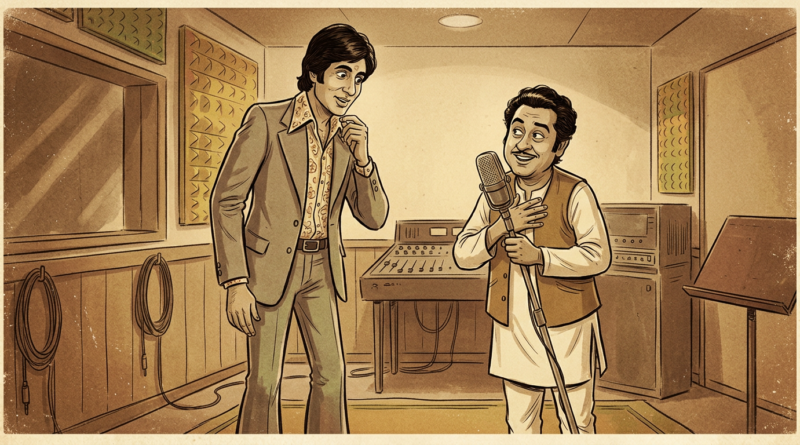
The anecdote, shared by Bachchan, transports us to a recording studio, a hallowed ground where cinematic history was often made. Kishore Kumar, known for his unique personality as much as his unparalleled vocal range, once mistook the towering superstar Amitabh Bachchan for his own son, Amit Kumar. Bachchan vividly recalls the moment: “He came and he said, ‘Amit, how are you?’ I said, ‘Kishore da, I am not Amit, I am Amitabh.’ He said, ‘Oh, you are Amitabh! I thought you were Amit.’” This momentary confusion, recounted with a touch of humor by Bachchan, perfectly encapsulates Kishore Kumar’s often-unpredictable nature.
This wasn’t merely a slip of the tongue; it was a testament to Kishore Kumar’s focus and perhaps his whimsical detachment from the immediate surroundings, even when in the presence of one of the biggest stars. It speaks volumes about the man who could effortlessly switch between profound emotion and playful antics, both in his singing and his life.
A Symphony of Collaboration: Bachchan and Kishore
The relationship between Amitabh Bachchan and Kishore Kumar was symbiotic. Kishore Kumar became the voice of Bachchan’s most iconic characters, lending his vocal prowess to chartbusters that defined a generation. From the energetic “My Name Is Anthony Gonsalves” to the soulful “Tere Mere Milan Ki Raina,” Kishore Kumar’s voice added layers of charisma and emotion to Bachchan’s on-screen persona. Their collaborations weren’t just songs; they were cultural phenomena, shaping the soundscape of Bollywood’s golden era. This anecdote, while seemingly minor, further humanizes these titans, showing a lighter, more personal side to their professional interactions.
Key Analysis: The Human Element of Legends
Such anecdotes are more than just entertaining stories; they serve as vital cultural artifacts. They humanize figures who often appear larger than life, bridging the gap between their iconic status and their personal quirks. Kishore Kumar’s eccentricities were well-documented, from his unique contracts to his playful interactions. This particular story adds another layer to his legend, showcasing his spontaneous, uninhibited spirit. For Amitabh Bachchan, recounting this story not only pays homage to a departed colleague but also reinforces his own image as a gracious, reflective superstar who cherishes these personal memories.
These stories offer invaluable insights into the working dynamics of Bollywood’s golden age, where immense talent often coexisted with unique personalities and informal camaraderie. They remind us that behind the glamour and the grand narratives, there were genuine human interactions, sometimes humorous, sometimes profound, but always memorable.
READ ALSO:
Why This Matters in the Long-Term
In an age dominated by digital content and curated personas, these authentic, personal anecdotes become increasingly precious. They contribute significantly to the enduring legacy of Amitabh Bachchan and Kishore Kumar. For future generations, these stories provide a richer, more nuanced understanding of these cultural icons than mere filmographies or discographies ever could. They paint a picture of an era, its personalities, and the unique chemistry that brewed behind the scenes, ensuring that the human element of these legends remains vibrant and accessible. Such tales keep their memory alive, not just as artists, but as fascinating individuals whose lives intertwined in remarkable ways, continuing to inspire and entertain long after their prime.