
These are the top 10 cosmic discoveries we expect from NASA’s Roman Space Telescope – Scientific American
Previously: Roman Telescope: Anticipating Cosmic Breakthroughs by 2026
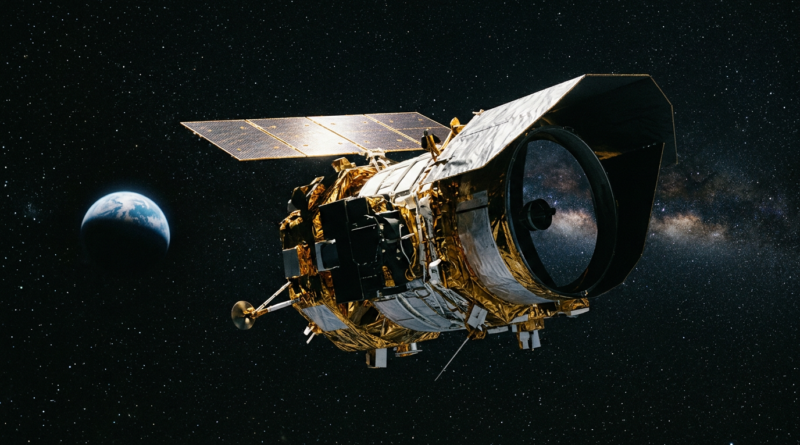
With its launch planned for the coming years, NASA’s Nancy Grace Roman Space Telescope is poised to begin one of the most ambitious data-gathering missions in the history of astronomy. As preparations continue for its journey to the second Lagrange point (L2), a stable gravitational point in space, we revisit the monumental scientific questions it was designed to answer.
Scheduled for launch before the end of the decade, the Roman Space Telescope represents the next generation of cosmic observatories. While telescopes like the James Webb Space Telescope (JWST) excel at deep, narrow-field observations, Roman is a survey instrument of unprecedented scale. Its Wide Field Instrument possesses a field of view significantly larger than that of the Hubble Space Telescope, with specific comparative figures not yet confirmed. This capability enables it to map vast swathes of the sky with incredible speed and precision. The expectations for Roman, as detailed in analyses like those from Scientific American, set a high bar for discovery that is now tantalizingly close to being tested.
Key Analysis: The Twin Pillars of Roman’s Mission
The telescope’s scientific program is built upon two foundational pillars: unraveling the secrets of dark energy and dark matter, and conducting a comprehensive census of exoplanets throughout our galaxy. These core objectives are designed to address some of the most pressing and fundamental questions in cosmology and astrophysics today.
The Hunt for Dark Energy and Dark Matter
The vast majority of the universe’s mass-energy content is believed to be composed of dark matter and dark energy, yet their fundamental nature remains one of modern science’s most profound mysteries. While the specific percentages are subject to ongoing refinement, their dominant role in the cosmos is undisputed. Roman will tackle this by employing several powerful techniques. Firstly, it will conduct a massive survey of Type Ia supernovae, using these ‘standard candles’ to measure the expansion history of the universe with unparalleled accuracy. Secondly, it will map the distribution of dark matter by observing the subtle distortions of light from distant galaxies, a phenomenon known as weak gravitational lensing. By creating the largest-ever 3D maps of the universe, Roman aims to provide the data needed to test competing theories of cosmology and potentially reveal the nature of the force driving cosmic acceleration.
A Galactic Census of Exoplanets
While NASA’s Kepler and TESS missions found thousands of planets using the transit method, Roman will primarily employ a different technique: gravitational microlensing. This method can detect planets at much greater distances from their stars, including those in cooler, outer orbits similar to Jupiter and Saturn, as well as planets orbiting very dim stars or even no star at all. These ‘rogue planets,’ untethered to any star, are thought to be common, and Roman’s survey is expected to be the first to provide a robust statistical measure of their population. This galactic planetary census will fundamentally reshape our understanding of planet formation and the architectural diversity of solar systems. The data will help scientists determine if our own solar system’s layout is common or a cosmic rarity.
Beyond the Core Mission: Technology and Synergy
In addition to its primary survey goals, Roman carries a sophisticated Coronagraph Instrument. This is a technology demonstration designed to test new methods for directly imaging giant exoplanets by blocking the overwhelming glare from their host stars. Success in this area would pave the way for future missions capable of imaging Earth-like planets. Furthermore, Roman’s role is not to operate in a vacuum. Its wide-field survey capabilities make it a perfect partner for other observatories. It can identify countless new, intriguing objects—from rogue planets to distant quasars—which can then be studied in greater detail by telescopes like JWST, creating a powerful synergy that will accelerate the pace of cosmic discovery for the next decade and beyond.
Frequently Asked Questions
What are the main scientific goals of the Roman Space Telescope?
Its primary goals are to study dark energy and dark matter through large-scale surveys and to conduct a comprehensive census of exoplanets using gravitational microlensing.
How is the Roman telescope different from the Hubble or Webb telescopes?
Roman is a survey telescope with a field of view 100 times larger than Hubble’s, designed to map vast areas of the sky quickly, whereas Hubble and Webb are designed for deep, narrow-field observations.
When is the Roman Space Telescope scheduled to launch?
The Nancy Grace Roman Space Telescope is scheduled to launch aboard a SpaceX Falcon Heavy rocket by May 2027.
This article was generated by AI based on publicly available news sources and may contain inaccuracies. For the original reporting, please refer to the cited sources. Learn more about our AI policy.