
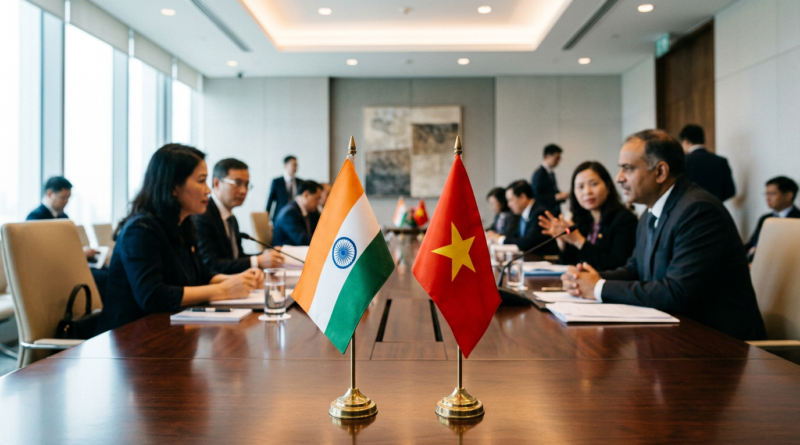
India and Vietnam Agree to Enhance Trade, Investment, and Technological Partnership
In a significant development for the Indo-Pacific region, India and Vietnam have mutually agreed to enhance their Comprehensive Strategic Partnership, with a renewed focus on deepening cooperation in trade, investment, and technology. The agreement, as reported by News On AIR, marks the next chapter in a robust relationship built on shared values and strategic interests, further solidifying the bond between the two nations.
This commitment is a cornerstone of India’s ‘Act East’ policy and aligns with Vietnam’s strategy of diversifying its global partnerships. By strengthening their collaboration, New Delhi and Hanoi are signaling a shared vision for a stable, prosperous, and rules-based Indo-Pacific. The move is widely interpreted as a strategic effort to build regional resilience and provide a counterbalance to growing assertiveness in the area, particularly concerning maritime security in the South China Sea—a vital waterway for both countries’ trade.
A Multi-Faceted Strategic Enhancement
The agreement is not merely a symbolic gesture but a framework for tangible progress across several critical sectors. While specific financial targets and investment figures are not yet confirmed, the stated goal is to substantially increase the volume of bilateral trade and facilitate a smoother flow of capital between the two dynamic economies. This involves creating more resilient and diversified supply chains, a lesson learned from recent global disruptions, thereby reducing over-reliance on single-country suppliers.
Analysts note that this enhanced partnership moves beyond traditional commerce. The emphasis on technology is particularly forward-looking, aiming to foster collaboration in areas crucial for future growth. Potential fields for joint initiatives include:
- Information Technology and Digital Transformation: Leveraging India’s mature IT service industry to support Vietnam’s rapid digitalization.
- Financial Technology (Fintech): Sharing expertise in digital payments and financial inclusion, where India has made significant strides.
- Green Energy: Cooperating on renewable energy projects, such as solar and wind power, to meet climate goals.
- High-Tech Manufacturing: Exploring joint ventures in electronics and other advanced manufacturing sectors.
Geopolitical Implications and Future Outlook
The decision to bolster this partnership carries significant geopolitical weight. It reinforces a network of like-minded nations in the region committed to upholding international law and ensuring freedom of navigation. For India, a stronger relationship with Vietnam, a key player in the Association of Southeast Asian Nations (ASEAN), serves as a crucial pillar of its engagement with Southeast Asia.
For Vietnam, partnering with a major global power like India provides economic opportunities and strategic depth, helping it navigate a complex regional landscape with greater autonomy. This agreement lays the essential groundwork for future, more advanced collaborations, potentially extending into defense manufacturing, cybersecurity, and space exploration. Ultimately, the strengthening India-Vietnam partnership serves as a powerful example of how middle powers can work together to foster mutual prosperity and contribute to regional stability in an increasingly multipolar world.
Frequently Asked Questions
What was the core of the India-Vietnam agreement from the mid-2020s?
According to reports, India and Vietnam agreed to enhance their partnership across the key sectors of trade, investment, and technology, aiming for deeper integration.
Why is the India-Vietnam partnership considered strategic?
The partnership is considered strategic due to shared interests in regional stability, freedom of navigation, and creating a counterbalance to regional power imbalances, particularly within the Indo-Pacific framework.
How does this partnership fit into India’s foreign policy?
This partnership is a key component of India’s ‘Act East’ policy, which focuses on strengthening economic and strategic relations with Southeast Asian nations.
This article was generated by AI based on publicly available news sources and may contain inaccuracies. For the original reporting, please refer to the cited sources. Learn more about our AI policy.