
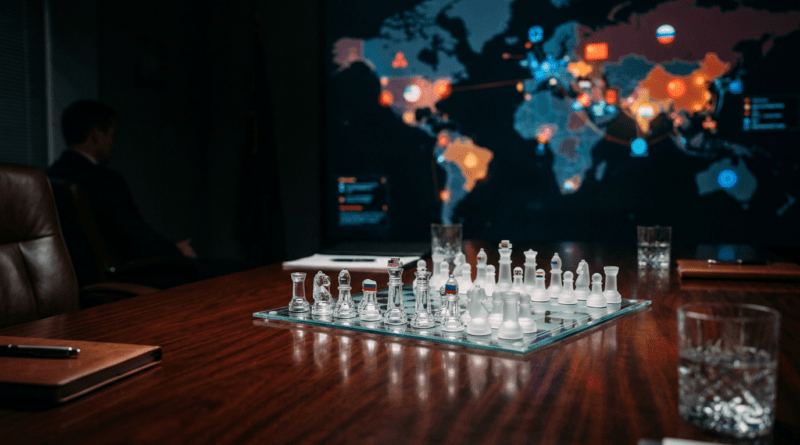
Forecasting the Next World War: Between Theory and Practice
Previously: Decoding Geopolitics: The Framework Shaping Our World
Navigating the Fog of War: The Science and Art of Predicting Global Conflict
In an era of shifting alliances and renewed great power competition, the question of a ‘next world war’ has moved from the realm of historical what-ifs to a sobering topic of contemporary analysis. The challenge of anticipating such a catastrophe is immense, residing in a complex space between academic theory and the unpredictable realities of statecraft. A recent analysis by E-International Relations, titled “Forecasting the Next World War: Between Theory and Practice,” illuminates this critical intellectual pursuit, examining the models and indicators experts use to scan the horizon for signs of global-scale conflict.
The relevance of such forecasting models is more pronounced than ever. The current international system, defined by a complex multipolarity and challenges to the post-Cold War order, presents a landscape ripe with potential flashpoints. The analysis explores the persistent gap between established international relations theories and the often-chaotic practice of diplomacy and military strategy, forcing us to consider which frameworks best equip us to understand and possibly preempt future conflicts.
The Theoretical Toolkit for Forecasting War
Forecasting global conflict is not mere guesswork; it is grounded in decades of political science theory. Proponents of Realism, for instance, argue that the international system is inherently anarchic. They focus on shifts in the material balance of power as the primary driver of war. From this perspective, a rising power challenging an established hegemon (a situation often dubbed the ‘Thucydides Trap’) creates an unstable environment where conflict becomes highly probable. Realists monitor indicators like military spending, arms races, and the formation of rival alliances, viewing international institutions as having limited ability to constrain the raw security interests of major states.
Conversely, the Liberal Internationalist school of thought offers a more optimistic, though not utopian, lens. It emphasizes the pacifying effects of economic interdependence, the spread of democratic governance (based on the democratic peace theory), and the power of international law and institutions. Liberals would argue that the dense web of global trade and the catastrophic economic fallout of a modern great power war create powerful deterrents. However, they also acknowledge that these guardrails can be eroded by aggressive nationalism, protectionism, or a severe global economic crisis. Figures on the exact level of economic interdependence required to prevent conflict are, of course, not yet confirmed and remain a subject of intense debate.
A third perspective, Constructivism, adds another layer of complexity. Constructivists argue that the material world of tanks and treaties is less important than the world of shared ideas, norms, and identities. For them, war becomes more or less likely depending on how states perceive one another and whether conflict is viewed as a legitimate instrument of policy. They would analyze the rhetoric of national leaders, the content of educational systems, and shifts in international norms to gauge the potential for hostilities.
The Practitioner’s Challenge: Translating Theory into Action
The E-International Relations piece highlights the profound difficulty of applying these grand theories to real-world prediction. In practice, intelligence agencies and political analysts employ a hybrid approach, monitoring a dashboard of tangible indicators. This includes traditional metrics like troop movements and defense budgets, but also increasingly incorporates non-traditional data. Analysts now scrutinize everything from satellite imagery of military bases to social media sentiment, looking for patterns that might precede an escalation. Key flashpoints in regions like Eastern Europe, the Indo-Pacific, and the Middle East are watched with particular intensity for any sign of miscalculation.
The rise of big data and artificial intelligence is also transforming the field, allowing for the processing of vast datasets to identify correlations that human analysts might miss. Yet, this technological shift comes with its own set of problems, including algorithmic bias and the risk of over-relying on quantitative models that may miss the nuances of human psychology and political will.
Why This Matters: Beyond the Crystal Ball
Ultimately, the exercise of forecasting a world war is not about achieving prophetic certainty. Such an event is a ‘black swan’—a low-probability, high-impact event that is nearly impossible to predict with precision. Instead, the value of this continuous analysis lies in identifying risk factors, understanding escalation pathways, and providing policymakers with the insights needed to manage tensions and reinforce diplomatic guardrails. By studying the gap between theory and practice, analysts can refine their models and offer more nuanced advice, helping leaders navigate an uncertain future and, ideally, steer the world away from the brink of catastrophe.
Frequently Asked Questions
What is the main subject of the analysis from E-International Relations?
The analysis examines the methods, both theoretical and practical, used by experts to forecast the possibility of a future major global conflict, or world war.
What are some theoretical frameworks used in forecasting global conflict?
Analysts often use international relations theories such as realism, which focuses on power competition between states, and liberalism, which emphasizes the role of international institutions and economic interdependence.
Are such forecasts considered definitive?
No, the analysis suggests there is a significant gap between theory and practice, and forecasting is inherently uncertain due to the complexity of global affairs and the potential for unforeseen events.
Image Credit: Editorial Illustration / The Pivot News AI
This article was generated by AI based on publicly available news sources and may contain inaccuracies. For the original reporting, please refer to the cited sources. Learn more about our AI policy.
Pingback: Penn Global Fellows 2026: Shaping Future Diplomacy - The Pivot News
Pingback: China's Foreign Policy: Analyzing the Four Seasons of Xi's Era - The Pivot News