
AI & SynBio Regulation: Navigating the 2026 Governance Gap
The Intelligence Ledger
The convergence of artificial intelligence, synthetic biology, and automation is creating capabilities previously confined to science fiction, but a critical governance gap threatens to undermine its potential. A new analysis in the journal Nature sounds the alarm on a growing ‘regulatory fragmentation,’ a patchwork of outdated and siloed rules ill-equipped to manage the power of these combined technologies.
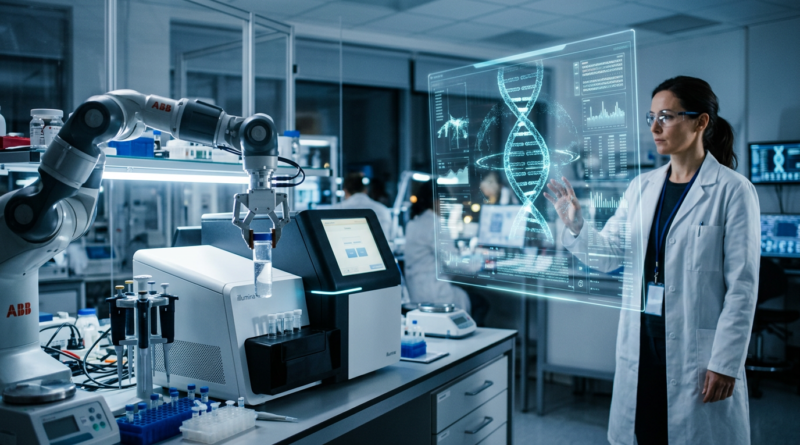
This technological trifecta represents a paradigm shift in scientific discovery. In what are often termed ‘cloud labs’ or ‘self-driving labs,’ AI algorithms can now design novel biological molecules, from proteins to entire genetic circuits. These designs are then passed to automated robotic systems that synthesize and test them at a scale and speed impossible for human researchers. While this fusion promises to accelerate solutions for medicine, climate change, and material science, the Nature report underscores the urgent challenge of governing it safely and ethically.
Key Analysis: The Dangers of a Fragmented Framework
The core problem, as highlighted by the analysis, is that regulations have not evolved in step with this technological convergence. Rules governing AI are typically developed separately from those for biotechnology, which are again distinct from standards for lab automation. This creates dangerous blind spots. Industry observers note that an action permissible under AI ethics guidelines might enable a high-risk outcome when executed by a biological synthesizer, an eventuality that neither regulatory body may have foreseen.
This fragmentation poses three distinct categories of risk:
- Biosecurity: The most pressing concern is the potential for misuse. A sufficiently advanced AI, guided by a malicious actor, could theoretically design a harmful pathogen. Automated systems could then synthesize it with minimal human oversight, bypassing traditional checks and balances that rely on human expertise and intervention.
- Ethical Accountability: If an AI-designed, robot-built organism causes unforeseen environmental damage or health issues, where does the responsibility lie? Is it with the AI developer, the user who set the experiment’s parameters, or the owner of the automated lab? Fragmented laws provide no clear answer, creating a vacuum of accountability.
- Economic and Social Equity: The immense power of these integrated platforms could concentrate R&D capabilities in the hands of a few corporations or nations. Without a global consensus on access and benefit-sharing, this technology could exacerbate global inequality rather than solve shared problems.
Why This Matters in the Long Run
The debate over regulating this convergence is not merely a technical or legal exercise; it is about setting the foundational rules for the next scientific revolution. The fusion of biology and computation is poised to become the primary engine of innovation for the 21st century. The regulatory frameworks established today, in 2026, will determine whether this powerful engine is steered toward equitable progress or drives us toward unforeseen perils. A failure to build a cohesive, global governance structure could lead to a ‘race to the bottom,’ where innovation outpaces safety, or a ‘chilling effect,’ where regulatory uncertainty stifles crucial research.
The call to action implicit in the Nature analysis is for international bodies, national governments, and the scientific community to collaborate on a new, integrated regulatory model. Such a framework must be adaptive, capable of evolving with the technology, and holistic, addressing the entire workflow from digital design to physical creation. The central question remains: can our governance structures learn and adapt as fast as our algorithms can?
Frequently Asked Questions
What is the convergence of AI, synthetic biology, and automation?
It is the integration of AI algorithms to design biological systems, synthetic biology to build them, and robotic automation to physically conduct the experiments at massive scale.
What does ‘regulatory fragmentation’ mean in this context?
It refers to the problem of having separate, uncoordinated rules for AI, biotechnology, and automation, which creates loopholes and blind spots when these technologies are used together.
What are the main risks of this fragmented regulation?
The primary risks include biosecurity threats from AI-designed pathogens, a lack of ethical accountability for unintended consequences, and increased economic inequality.
This article was generated by AI based on publicly available news sources and may contain inaccuracies. For the original reporting, please refer to the cited sources. Learn more about our AI policy.