
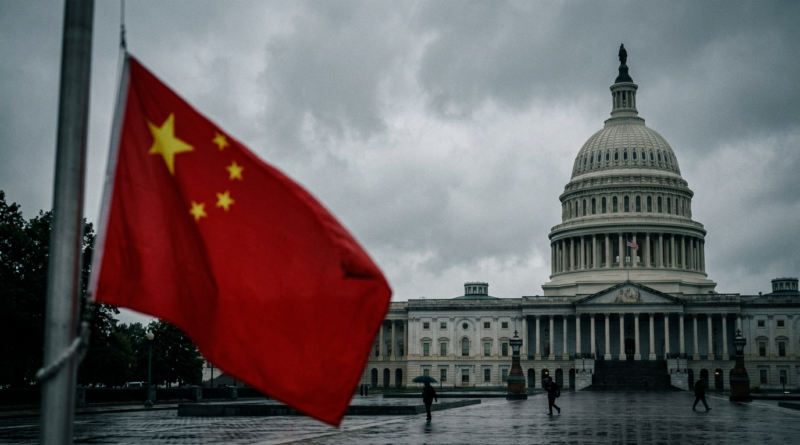
China – US Investment: A Security Threat or an Opening to Reform the World’s Most Important Economic Relationship? – Quincy Institute for Responsible Statecraft
Previously: India’s Strategic Roads: A 2026 Retrospective on Geopolitical Buoyancy
WASHINGTON D.C. – A fierce and consequential debate is unfolding in Washington over the nature of U.S. investment in China. Policymakers, analysts, and business leaders are grappling with a fundamental question: does the flow of American capital into Chinese industries represent an unacceptable national security threat, or is it a vital tool for engagement and a potential opening to reform the world’s most critical economic relationship? Think tanks like the Quincy Institute for Responsible Statecraft are at the forefront of this discourse, offering critical analysis that challenges prevailing narratives and shapes the policy options under consideration.
At the heart of the security concerns is Beijing’s well-documented military-civil fusion strategy. This national strategy explicitly aims to leverage developments in the civilian sector, including from private companies, to advance China’s military modernization. For many in the U.S. security establishment, this blurs the line between commercial and military enterprise, raising fears that American investments—particularly in high-tech sectors like artificial intelligence, quantum computing, semiconductors, and biotechnology—are inadvertently fueling the capabilities of a primary strategic competitor. This perspective has gained significant bipartisan traction, leading to concrete policy actions, including the development of outbound investment screening mechanisms designed to curb capital flows to specific Chinese entities.
The Push for Stringent Controls
Proponents of a hardline approach argue that the Chinese Communist Party’s influence over the private sector is so pervasive that any U.S. investment carries an inherent risk. From this viewpoint, it’s not just about preventing the direct transfer of dual-use technology, but also about denying China access to American capital, managerial expertise, and the institutional know-how that could bolster its economic and military power. This has led to a strategy often described as “de-risking,” which seeks to selectively disentangle U.S. supply chains and financial ties from Chinese sectors deemed critical to national security. The goal is to build resilience and reduce vulnerabilities without pursuing a full-scale, and likely catastrophic, economic decoupling. Specific figures on the total investment in these sensitive sectors remain a subject of intense study, with official data not yet fully confirmed or released publicly.
An Alternative Vision: The Quincy Institute’s ‘Small Yard, High Fence’
Conversely, organizations like the Quincy Institute for Responsible Statecraft advocate for a more nuanced and targeted approach. They argue that overly broad, sweeping restrictions on investment could prove counterproductive. Such policies risk harming U.S. economic competitiveness by cutting American firms off from the world’s second-largest economy, and could provoke Beijing by further isolating it, potentially leading to more aggressive and less predictable behavior on the world stage.
Instead, the Quincy Institute and others champion a “small yard, high fence” strategy. This concept involves meticulously identifying a narrow, well-defined set of technologies and capabilities that are truly critical to U.S. national security (the “small yard”) and then erecting impassable barriers to protect them (the “high fence”). Outside of this strictly controlled space, other forms of trade and investment should be allowed to continue. The core of this argument is that continued economic interdependence, when properly managed, provides the United States with leverage, maintains open channels for diplomacy, and creates opportunities to collaboratively address global challenges like climate change and pandemics. It preserves the possibility of using economic ties not as a weapon, but as an opening to encourage gradual reform within the global economic architecture.
A Defining Moment for Global Economics
The resolution of this debate will have profound, long-term implications. The path Washington chooses will not only define the future trajectory of the U.S.-China relationship but will also send a powerful signal to allies and partners around the world who are conducting their own reviews of their economic ties with China. The challenge lies in forging a policy that effectively neutralizes genuine security threats without sacrificing the benefits of global economic integration or triggering a wider geopolitical schism. As policymakers weigh these competing visions, the final shape of America’s economic statecraft toward China remains one of the most pressing issues of our time.
Frequently Asked Questions
What was the central debate regarding US investment in China in the early 2020s?
The central debate was whether US investment in China posed a national security threat that required restriction, or if it was an opportunity for engagement and reform of the economic relationship.
What was the primary argument for viewing US-China investment as a security threat?
The main argument was that China’s military-civil fusion strategy meant US capital could inadvertently fund the development of a strategic competitor, particularly in high-tech sectors like AI and biotech.
What was the counter-argument for maintaining investment ties with China?
The counter-argument, advanced by groups like the Quincy Institute, was that broad restrictions would be self-defeating, advocating instead for narrowly targeted controls (‘small yard, high fence’) to maintain economic leverage and diplomatic channels.
This article was generated by AI based on publicly available news sources and may contain inaccuracies. For the original reporting, please refer to the cited sources. Learn more about our AI policy.