
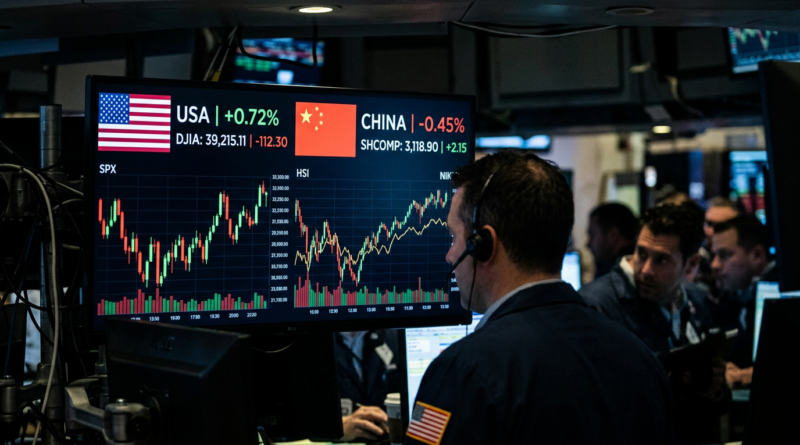
US-China Investment: Security Threat or Diplomatic Opening?
Previously: India and Vietnam Agree to Enhance Trade, Investment, and Technological Partnership
Hook: The intricate flow of capital between the United States and China represents one of the most critical and contentious issues in modern geopolitics. From the perspective of August 2026, this financial interdependence is increasingly viewed through a dual lens: as a paramount national security threat and, simultaneously, as the most viable opening to reform the world’s most consequential economic relationship.
Context: The debate over the nature of US-China investment is not a new phenomenon, but its intensity has grown substantially over the past decade. This discussion, framed pointedly by analyses like those from the Quincy Institute for Responsible Statecraft, questions the fundamental value of deep economic integration between strategic rivals. For decades following China’s accession to the World Trade Organization (WTO), the prevailing consensus in Washington D.C. held that investment would foster political liberalization in Beijing. However, by the late 2010s, this view had been replaced by widespread concern over strategic competition, leading to a fundamental re-evaluation that continues to shape policy in 2026.
Key Analysis: A Tale of Two Perspectives
The discourse surrounding bilateral investment is sharply polarized, reflecting two divergent theories of international relations and economic statecraft.
The ‘Security Threat’ Doctrine
Proponents of this view argue that unfettered investment poses a clear and present danger to national security. From this perspective, Chinese investment in sensitive US sectors—such as technology, infrastructure, and telecommunications—is seen as a potential vector for espionage, intellectual property theft, and undue political influence. Regulatory bodies like the Committee on Foreign Investment in the United States (CFIUS) have expanded their mandates in response to these concerns. Conversely, US investment in China is scrutinized for potentially funding the development of technologies used for military modernization or domestic surveillance, thereby creating a scenario where American capital inadvertently strengthens a primary strategic competitor.
The ‘Opening for Reform’ Argument
In contrast, a significant contingent of diplomats, economists, and analysts posits that economic entanglement, while complex, is a crucial stabilizing force. This school of thought suggests that a full-scale economic decoupling would be both practically unfeasible and dangerously destabilizing, increasing the risk of miscalculation and conflict. According to this perspective, investment creates vital channels for communication and dialogue. It forces both nations to engage within established frameworks like the G20 and the WTO, providing a platform to negotiate rules and address global challenges such as climate change, pandemic preparedness, and financial stability. This view advocates for a “small yard, high fence” approach—narrowly targeting restrictions on critical technologies while allowing broader commercial ties to continue.
Why This Matters in the Long Run
The path chosen by Washington and Beijing on this issue will fundamentally shape the 21st-century global order. A continued drift towards securitization and decoupling risks bifurcating the global economy, creating rival technological ecosystems and supply chains. This could force other nations, including major players like India and the European Union, into difficult strategic choices, potentially undermining the multilateral system. Conversely, finding a sustainable framework for managing investment could lay the groundwork for a more stable, albeit competitive, relationship. Such a framework would need to balance legitimate security concerns with the undeniable benefits of economic cooperation, setting a precedent for how great powers manage rivalry in an interconnected world.
Conclusion: As of 2026, the central question of whether US-China investment is a threat or an opportunity remains unresolved. The primary challenge for global policymakers is not to definitively choose one interpretation, but to craft policies that skillfully navigate the inherent and enduring tension between these two realities.
Frequently Asked Questions
What is the core debate surrounding US-China investment?
The core debate is whether the flow of capital between the US and China is primarily a national security threat or a crucial opportunity for diplomatic engagement and economic reform.
What is the ‘security threat’ argument against US-China investment?
This argument posits that investment can be a channel for espionage, intellectual property theft, and the inadvertent funding of a strategic rival’s military and surveillance capabilities.
What is the ‘opening for reform’ argument for US-China investment?
This perspective suggests that economic interdependence creates vital channels for dialogue, stabilizes the relationship, and encourages cooperation on global issues, arguing that decoupling is impractical and dangerous.
This article was generated by AI based on publicly available news sources and may contain inaccuracies. For the original reporting, please refer to the cited sources. Learn more about our AI policy.