
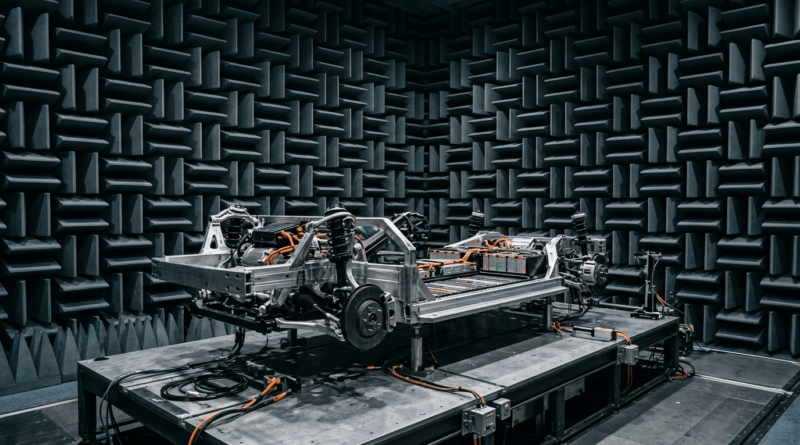
NVH Tech’s Future: How EVs Are Redefining Vehicle Silence 2026
The race to build the perfect electric vehicle has created an unexpected engineering challenge: silence. As the noisy internal combustion engine disappears, a host of other subtle sounds—from tire hum to inverter whine—are becoming prominent, forcing a fundamental reinvention of Noise, Vibration, and Harshness (NVH) technology.

Hostinger Cloud Hosting: Ultra-Fast NVMe Storage & 99.9% Uptime Guarantee
Power your high-traffic WordPress websites with managed cloud infrastructure, automated daily backups, free SSL, and 24/7 expert support.
According to a new analysis highlighted by Tech Briefs, the automotive industry is in the midst of a critical pivot in how it manages the in-cabin experience. For decades, NVH engineering focused on mitigating the powerful, low-frequency rumble of gasoline and diesel engines. Now, with battery electric vehicles (BEVs) providing a near-silent powertrain, the acoustic landscape of a car has been completely altered. This shift demands a new suite of tools and philosophies to address a different spectrum of sounds and sensations that impact driver and passenger comfort.
Key Analysis: The New Acoustic Battleground
The core challenge stems from a phenomenon known as ‘masking’. The constant noise of an internal combustion engine (ICE) effectively masked a variety of other sounds. Without this acoustic blanket, NVH engineers are now battling issues that were previously irrelevant. Industry observers note that the focus has shifted to high-frequency noises from electric motors and power electronics, wind noise over more aerodynamic bodies, and road noise transmitted through lightweight chassis structures designed to maximize range.
From Passive Insulation to Active Cancellation
Traditionally, NVH was a game of adding mass—heavy layers of foam and rubber insulation to absorb and block sound. This approach is antithetical to EV design, where every gram of weight is scrutinized to improve efficiency and battery range. The future, as outlined in the analysis, lies in software and active systems. Technologies like Active Noise Control (ANC), similar to that found in premium headphones, use microphones to detect unwanted ambient sounds and generate opposing sound waves through the car’s speakers to cancel them out in real-time. This allows for a quiet cabin without the weight penalty of passive materials.
Simulation and the Digital Twin
Furthermore, the development process itself is being transformed. Advanced simulation and the creation of ‘digital twins’ are becoming indispensable. Automakers can now build a complete virtual model of a vehicle and subject it to a battery of NVH tests in a digital environment. This allows engineers to identify and resolve potential noise and vibration issues early in the design phase, long before a costly physical prototype is ever built, dramatically accelerating development and refinement.
Why This Matters in the Long Run
Mastering the new science of NVH is not merely an engineering exercise; it is becoming a crucial brand differentiator that will define the next generation of luxury and comfort. As vehicles trend towards full autonomy, the cabin transforms from a cockpit into a mobile living space or office. In this future, a serene, distraction-free environment is not a feature—it is the core product. The companies that excel in creating a superior sensory experience will command the market, proving that in the electric era, the sound of silence is a complex and valuable technological achievement.
Ultimately, the evolution of NVH technology reflects the broader maturation of the electric and autonomous vehicle sectors, shifting the focus from baseline functionality to the nuanced quality of the human experience inside the machine.
Frequently Asked Questions
What is NVH technology?
NVH stands for Noise, Vibration, and Harshness. It is the field of engineering focused on optimizing the sound and feel of a vehicle for driver and passenger comfort.
Why is NVH a bigger challenge for electric vehicles (EVs)?
The silent powertrain of an EV no longer masks other noises like wind, tires, and electric motor whine, making them more noticeable and requiring new engineering solutions.
What are modern solutions for NVH in new vehicles?
Modern solutions are shifting from heavy passive insulation to active systems like Active Noise Control (ANC) and extensive use of digital simulation to solve issues before production.
Image Credit: Editorial Illustration / The Pivot News AI
This article was generated by AI based on publicly available news sources and may contain inaccuracies. For the original reporting, please refer to the cited sources. Learn more about our AI policy.