
India’s Strategic Roads: A 2026 Retrospective on Geopolitical Buoyancy
From our vantage point in mid-2026, it is clear that India‘s sustained and ambitious border infrastructure drive over the past decade has become a defining pillar of its foreign policy. The strategy, once seen as a reactive measure, has matured into a proactive assertion of sovereignty and a critical tool for achieving what analysts now term ‘geopolitical buoyancy’.
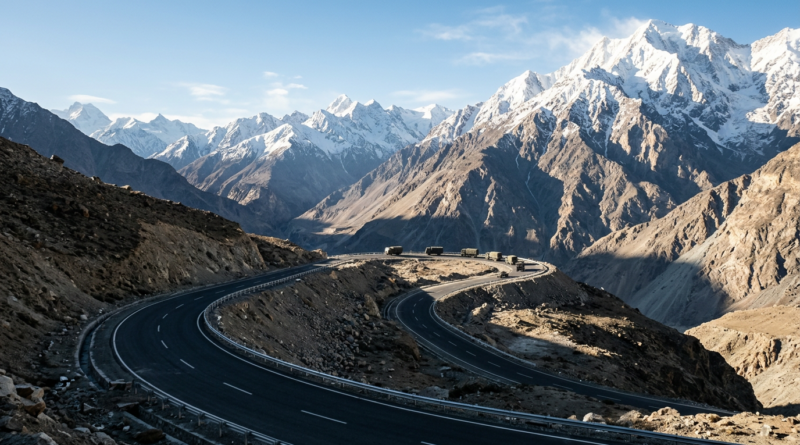
The impetus for this large-scale strategic construction, primarily executed by the Border Roads Organisation (BRO), gained significant momentum following the border standoffs with China that began in 2020. Looking back, the concerted push to build all-weather roads, tunnels, and bridges across challenging Himalayan terrain in regions like Ladakh and Arunachal Pradesh was not merely an engineering feat but a calculated geopolitical statement. This network has fundamentally altered the strategic calculus along the Line of Actual Control (LAC).
Key Analysis: A Multi-Pronged Impact
The development of this strategic road network has been interpreted through various lenses on the international stage, reflecting the complex dynamics of regional power balances.
The Indian Perspective: Security and Integration
From New Delhi’s standpoint, the primary objective has been twofold. First, to ensure rapid and seamless mobility for its armed forces, thus reducing deployment times and enabling a more robust defensive posture. The infrastructure allows for quicker reinforcement of frontline positions and improved logistical support. Second, the policy serves to integrate remote border populations into the national economic mainstream, aiming to foster development and counter external influence through improved connectivity and access to services.
The View from Beijing and Islamabad
Neighboring states, particularly China and Pakistan, have consistently viewed India’s infrastructure development with suspicion. Reports from past years indicate that Beijing has often characterized the construction, especially in Arunachal Pradesh, as an attempt to unilaterally alter the status quo along the disputed border. This has, in turn, been used to justify its own extensive infrastructure and village-building activities on its side of the LAC. The strategic alignment between China and Pakistan means that any enhancement of India’s military logistics is seen as a direct challenge to their collective interests.
Global and Quad Reactions
For international observers and partners within alliances like the Quadrilateral Security Dialogue (Quad), India’s infrastructural assertiveness is largely seen as a positive development. Partners such as the United States, Japan, and Australia have viewed it as India stepping up to its role as a net security provider in the Indo-Pacific. This capability enhancement is considered a crucial element in creating a strategic counterweight to China’s expanding influence, aligning with the broader goal of maintaining a free and open Indo-Pacific. The roads are physical manifestations of India’s commitment to defending its territorial integrity, a principle supported by its Quad partners.
Why This Matters in the Long Run
In the long-term, this strategic road network does more than just secure borders; it positions India as a more credible and capable regional anchor. It enhances its potential to create alternative economic corridors, such as connections to Southeast Asia, bypassing traditional choke points. This ‘geopolitical buoyancy’ allows India to navigate the turbulent waters of great power competition with greater resilience and independence. While the strategy has undeniably increased friction along the LAC, it has also provided New Delhi with greater leverage in international forums, from the G20 to BRICS, by demonstrating a commitment to backing its diplomatic positions with on-the-ground capabilities.
The ultimate success of this strategy will be measured not just in kilometers of tarmac, but in its ability to maintain stability and deter aggression without tipping the region into open conflict. As of 2026, the roads have provided India with strategic depth, but the path ahead remains one of cautious navigation.
Frequently Asked Questions
What was the primary goal of India’s strategic road-building initiative?
The main goals were to enhance military mobility for rapid troop deployment along its borders, and to promote economic development and integration for remote border communities.
Which organization has been primarily responsible for this construction?
The Border Roads Organisation (BRO), a part of the Indian Armed Forces, has been the lead agency for planning and executing the development of roads in India’s border areas.
How did the international community, like the Quad, view this strategy?
Partners in the Quad (US, Japan, Australia) generally viewed India’s infrastructure development positively, seeing it as India bolstering its capacity to act as a counterweight to China’s influence in the Indo-Pacific region.
This article was generated by AI based on publicly available news sources and may contain inaccuracies. For the original reporting, please refer to the cited sources. Learn more about our AI policy.