
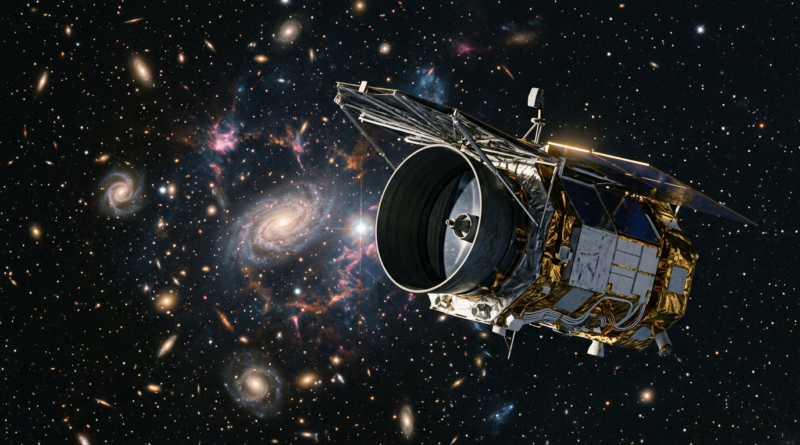
Roman Telescope: Anticipating Cosmic Breakthroughs by 2026
NASA’s Roman Space Telescope: Awaiting Transformative Discoveries
As of August 29, 2026, the scientific community eagerly awaits the launch of NASA’s Nancy Grace Roman Space Telescope, slated for May 2027. This next-generation observatory promises to revolutionize our understanding of the cosmos, building upon the legacies of Hubble and Webb. A Scientific American article, published prior to 2026, outlined ten highly anticipated cosmic discoveries expected from Roman, a testament to the telescope’s unprecedented capabilities even before its operational phase.
Key Analysis: Unlocking the Universe’s Deepest Secrets
The Roman Space Telescope, previously known as WFIRST (Wide Field Infrared Survey Telescope), is designed to tackle some of the most profound questions in astrophysics. Its primary instruments include a 2.4-meter primary mirror, identical in size to Hubble’s, but paired with a Wide Field Instrument (WFI) that captures a field of view 100 times larger than Hubble’s infrared camera. This expansive view is crucial for its ambitious scientific objectives.
The ten cosmic discoveries highlighted by Scientific American underscore Roman’s multi-faceted mission. These expectations largely center on two pillars: the mysteries of dark energy and the census of exoplanets. Roman will employ the weak gravitational lensing technique to precisely map the distribution of dark matter and measure the expansion history of the universe, providing critical data to constrain models of dark energy. Furthermore, its advanced coronagraph instrument and microlensing survey will enable the direct imaging of exoplanets and the detection of thousands more, including those in the outer regions of planetary systems, offering insights into planetary formation and habitability beyond our solar system. The telescope is also poised to conduct extensive surveys of galaxies, tracing their evolution over cosmic time.
While the specific details of the ten discoveries remain to be unveiled by Roman itself, the broad categories reflect the observatory’s core design. These anticipated breakthroughs represent a significant leap in observational astronomy, promising to redefine our cosmological models and deepen our understanding of our place in the universe. Agencies like NASA and ESA collaborate on various space missions, and the data from Roman will undoubtedly complement observations from facilities like ISRO’s upcoming X-ray Polarimeter Satellite and SpaceX’s Starship-launched observatories.
Why This Matters in the Long Run
The Roman Space Telescope’s expected contributions extend far beyond its initial mission. By providing an unparalleled wide-field view in infrared, it will create vast data archives invaluable for future generations of astronomers. Its findings on dark energy could confirm or refute existing theories, potentially leading to a paradigm shift in fundamental physics. The exoplanet census will inform target selection for future missions dedicated to searching for biosignatures, ultimately advancing humanity’s quest for life beyond Earth. Roman’s legacy will be a comprehensive, high-resolution map of the infrared universe, a cornerstone for cosmic exploration for decades to come.
As the countdown to its 2027 launch continues, the scientific community holds its breath for the transformative insights NASA’s Roman Space Telescope is poised to deliver.
Frequently Asked Questions
What is the primary mission of NASA’s Roman Space Telescope?
The Roman Space Telescope’s primary mission is to make transformative cosmic discoveries, particularly in understanding dark energy and conducting a comprehensive census of exoplanets.
When is the Roman Space Telescope expected to launch?
As of August 29, 2026, the NASA Roman Space Telescope is slated for launch in May 2027.
What types of discoveries are anticipated from the Roman Space Telescope?
The Roman Space Telescope is anticipated to make discoveries related to probing the mysteries of dark energy, detecting and characterizing thousands of exoplanets, and mapping the evolution of galaxies over cosmic time.
This article was generated by AI based on publicly available news sources and may contain inaccuracies. For the original reporting, please refer to the cited sources. Learn more about our AI policy.